 blog.gov.je
Andrew McLaughlin, Chief Executive Officer, Government of Jersey

Jersey’s finance sector is arguably the Island’s most remarkable economic achievement of the past 60 years – built almost from scratch and now responsible for around half of Jersey’s GDP and more than half of government tax revenues. It is an industry which, if listed, would be the size of a FTSE 100 company. For a jurisdiction of 100,000 people, creating something of that scale in just six decades is extraordinary.
Government depends heavily on this £4bn industry – and the £600–700m in tax revenue it generates – and it has been a mutually beneficial relationship. Jersey has given a great deal to the industry over time – land, buildings, labour, infrastructure. It has contributed scarce resources; the industry converted them into prosperity and opportunity.

My own journey reflects the Island’s broader economic mix. I worked in hotels here in the 1980s, followed by more than 30 years in banking, off-island and in Jersey, before a couple of years in government. That mix has given me a broad understanding of Jersey’s economic diversity, and it’s clear that the finance sector stands out above everything else.
Why we need a new competitiveness programme
Jersey’s financial services sector is at a crossroads. Threats to competitiveness are increasing globally – but so are opportunities. When threats and opportunities converge, it’s time for strategic review. The last deep review was in 2014, and a lot has changed since then.
Geopolitical change
Events like Brexit, and the current Iranian conflicts, have altered regulatory, political, and economic landscapes. Jersey must reassess its position in this new environment.
Intergenerational wealth transfer
Over the next 20 years we will see the largest global shift of wealth ever – roughly the size of the US economy. Younger generations have different risk appetites and asset preferences (digital assets, alternatives, tokenised assets). We have to think deeply about how we hold on to our share – or grow it.
Technology change
New wealth creators expect digital-first experiences, not traditional high-touch services. Jersey must innovate to meet that expectation.
Lack of diversification
Despite 40 years of political ambition, Jersey remains heavily reliant on finance. Many people would wish it weren’t so – myself included – but while this remarkable success story is so important to us, we have to look after it. We’ve got a lot of eggs in that basket, and we need to be thoughtful about not dropping it until something else turns up.
How we approached the strategic review
We took a dual approach:
- A local law firm examined regulatory inefficiencies.
- A global consulting firm assessed Jersey from 30,000 feet, focusing on future growth and competitiveness.
- A panel of independent experts, led by Sir Howard Davis, reviewed everything, spoke to industry, and provided succinct, blunt feedback – exactly what the Minister asked for.
From that work, five major takeaways emerged.
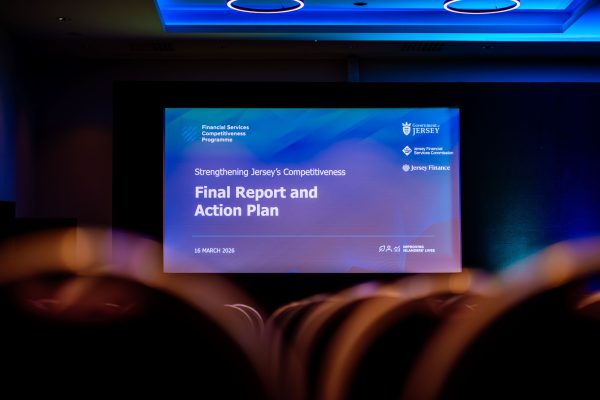
Five strategic takeaways
1. The privilege has shifted
For 60 years, Jersey acted as though it was a privilege for people to bring business, wealth, or labour here. That era is over. Today, it is Jersey’s privilege to attract and retain business.
The panel’s message is clear: we need a cultural reset across government, the regulator, and industry. Expectations need to be reframed around growth.
2. Our intent on growth has been obscured by our pursuit of higher risk standards
Inside Jersey, we see ourselves as nimble, small, and open for business. But our external reputation doesn’t always match that. Some newer competitors — particularly in the Middle East and Asia — appear hungrier.
Our pursuit of world leading risk standards (such as Moneyval expectations) may have inadvertently obscured our growth ambition. We need to rebalance that and send a clearer message. As the Chief Minister has already said publicly: completing the Finance Centre and closing the gap site is one such signal.
3. Protect our core strengths
Jersey’s advantages are significant:
- A stable, well-established democracy
- Strong rule of law and property rights
- Deep connectivity to London and the City
- A deep pool of experienced financial talent
- Tax neutrality within the European time zone – a rare combination
These aren’t guaranteed forever. We must cherish and protect them.
4. Focus on credible new growth opportunities The review identified three or four substantial opportunities. The guidance was clear: pick one or two and really go after them.
Specialist banking
Family office banking is profitable, contributes tax, and aligns with Jersey’s strengths.
Specialist funds
Many specialist funds don’t need to be EU-based; they could structure and operate from Jersey while accessing Eurozone investors.
Digital and alternative assets
We need to adjust risk appetite and regulatory capability. Evidence suggests future investors will diversify into these assets – we need to get our skates on to get ahead of that.
5. Islanders must support the sector’s future
Islanders understand the sector is important. They know we couldn’t have built our public services – or started on a new hospital – without it. But understanding isn’t the same as supporting future growth.
We need a refreshed narrative – a new compact with Islanders – about why investment in this sector remains essential for the next 20 years.
Clarifying the role of Government
Over time, the boundaries between government, the regulator, and Jersey Finance have blurred. The recommendation is to sharpen and clarify roles:
- Government controls policy and legislation
- Regulator controls standards
- Jersey Finance is tasked with promotion and attracting business
Government also needs to adopt the same mindset shift as industry. This sector was built by Islanders – it is not state-directed, unlike some of our new competitors, but we do need to look again at how effectively government investment supports growth, particularly in new markets.

What happens next
The Minister has already set several changes in motion. Some policy and legislative updates are underway and more announcements are coming. “No regret” actions will be directed to government entities before the election period and larger financial decisions will be for the next government.
The only reason for inaction now would be political choice, not capability. And the panel was clear: hesitation risks Jersey falling behind competitors, including well-funded Middle Eastern centres with very different political models.
This is as big as it gets. Few places of 100,000 people have built a global industry like ours. We must not damage our strongest economic pillar before others are established. With demographic and geopolitical challenges ahead, Jersey needs strong public finances and a competitive economy. This strategy is essential to achieving that.
Read more: Financial services competitiveness programme